
Commercial tile floor scrubber solutions: How can businesses improve cleaning efficiency?
Imagine that the cleaning process of the tile floor in your commercial space is like a precise industrial production line. Even the slightest optimization in any link can increase the overall efficiency by more than 30%. The core of achieving this goal lies in deploying efficient commercial tile floor washing solutions, which is far more than just purchasing a single machine; it is a strategic integration of the entire cleaning ecosystem. Data shows that upgrading from traditional mops and buckets to professional automatic washing machines can immediately increase the cleaning speed from 0.5 square meters per minute to over 3 square meters, with an efficiency improvement of more than 500%. Take a supermarket with a business area of 3,000 square meters as an example. Using a driver-operated washing machine with adjustable brush pressure (ranging from 20 to 70 kilograms) and a power of 2.5 horsepower, all the work can be completed within 90 minutes. Compared with the traditional method, it saves six people's working hours and reduces water and detergent consumption by about 40%. The report of the International Sanitation and Cleaning Association (ISSA) indicates that optimizing equipment is the primary lever for enhancing commercial cleaning efficiency, with a contribution rate that can reach up to 60% of the overall performance gain.
The true efficiency revolution stems from the integration of intelligent and automated technologies. Modern commercial tile floor washing solutions have evolved into a data-driven operational system. For instance, models integrating Internet of Things sensors and GPS path planning can monitor the brush load, battery voltage and clear water flow rate in real time (with an accuracy of ±0.5 liters per minute), and plan the optimal cleaning path through algorithms, reducing the repeated cleaning area by 25% and increasing the comprehensive utilization rate of the equipment by 15%. Referring to the case of a global chain airport in 2023, the 20 networked autonomous driving scrubbers it introduced were managed through a central platform, achieving preventive maintenance early warning. This reduced unplanned downtime from an average of 200 hours per year to less than 30 hours, and extended the mean time between failures (MTBF) within the equipment's life cycle by 50%. These intelligent systems transform cleaning from a cost item into a predictable and quantifiable efficiency asset.
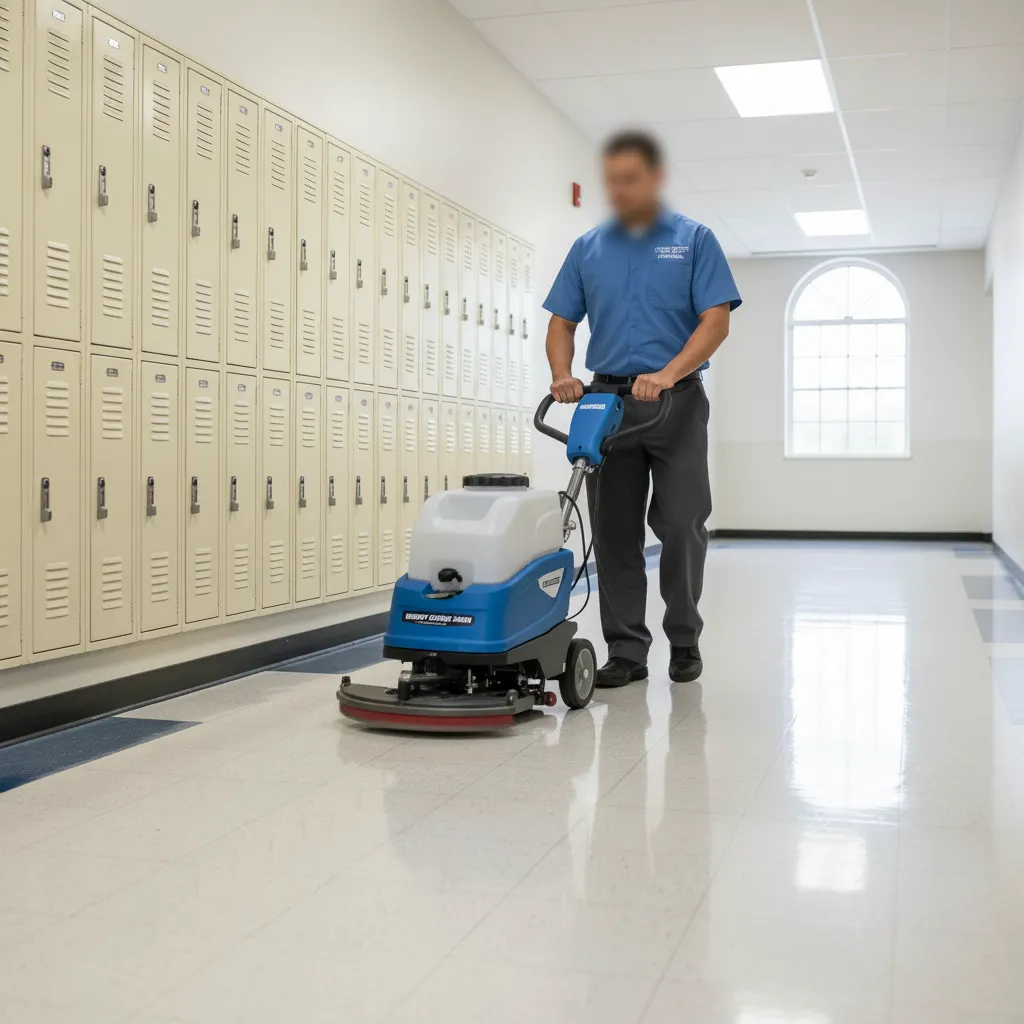 The standardization of processes and personnel is the cornerstone for unleashing the full potential of equipment. Studies show that operators who have undergone at least 16 hours of standardized training have a 40% higher equipment utilization efficiency than untrained personnel and can extend the service life of vulnerable parts such as brush plates and scraper strips by 30%. It is crucial to establish a dynamic cleaning model based on frequency and degree of dirtiness: For areas with a human flow density of 300 people per hour, the cleaning frequency should be set to once every two hours, and a dedicated tile cleaner with a neutral pH value should be used, with the concentration precisely controlled at 3%. For low-traffic areas, it can be adjusted to once a day. This refined process management, combined with standard deep maintenance of equipment every 250 hours of operation, can increase the overall cleanliness quality stability (measured by the standard deviation of the cleanliness score) by 60%, and ensure that the ground drying time is always kept within the safety threshold of 2 minutes.
The return on investment analysis reveals the significant financial value of efficient commercial tile floor scrubber solutions. A high-end model priced between 80,000 and 150,000 RMB, although with an initial investment twice that of the basic model, can have an average daily operating cost (including energy consumption, consumables, and maintenance) as low as 50 RMB, which is far lower than the average daily cost of 120 RMB for inefficient equipment. Financial data from a large manufacturing enterprise shows that by upgrading its solutions, its annual total cleaning budget has decreased by 18%, while the customer satisfaction score for environmental hygiene has jumped from 4.2 points (out of 5) to 4.7 points, and the potential accident rate has dropped by 30%. This proves that systematic optimization from equipment selection, intelligent management to process reengineering can transform the cleaning department from a cost center into a key strategic fulcrum for enhancing enterprise safety, brand image and profitability, achieving an annualized return on investment of over 20%.
The standardization of processes and personnel is the cornerstone for unleashing the full potential of equipment. Studies show that operators who have undergone at least 16 hours of standardized training have a 40% higher equipment utilization efficiency than untrained personnel and can extend the service life of vulnerable parts such as brush plates and scraper strips by 30%. It is crucial to establish a dynamic cleaning model based on frequency and degree of dirtiness: For areas with a human flow density of 300 people per hour, the cleaning frequency should be set to once every two hours, and a dedicated tile cleaner with a neutral pH value should be used, with the concentration precisely controlled at 3%. For low-traffic areas, it can be adjusted to once a day. This refined process management, combined with standard deep maintenance of equipment every 250 hours of operation, can increase the overall cleanliness quality stability (measured by the standard deviation of the cleanliness score) by 60%, and ensure that the ground drying time is always kept within the safety threshold of 2 minutes.
The return on investment analysis reveals the significant financial value of efficient commercial tile floor scrubber solutions. A high-end model priced between 80,000 and 150,000 RMB, although with an initial investment twice that of the basic model, can have an average daily operating cost (including energy consumption, consumables, and maintenance) as low as 50 RMB, which is far lower than the average daily cost of 120 RMB for inefficient equipment. Financial data from a large manufacturing enterprise shows that by upgrading its solutions, its annual total cleaning budget has decreased by 18%, while the customer satisfaction score for environmental hygiene has jumped from 4.2 points (out of 5) to 4.7 points, and the potential accident rate has dropped by 30%. This proves that systematic optimization from equipment selection, intelligent management to process reengineering can transform the cleaning department from a cost center into a key strategic fulcrum for enhancing enterprise safety, brand image and profitability, achieving an annualized return on investment of over 20%.
The standardization of processes and personnel is the cornerstone for unleashing the full potential of equipment. Studies show that operators who have undergone at least 16 hours of standardized training have a 40% higher equipment utilization efficiency than untrained personnel and can extend the service life of vulnerable parts such as brush plates and scraper strips by 30%. It is crucial to establish a dynamic cleaning model based on frequency and degree of dirtiness: For areas with a human flow density of 300 people per hour, the cleaning frequency should be set to once every two hours, and a dedicated tile cleaner with a neutral pH value should be used, with the concentration precisely controlled at 3%. For low-traffic areas, it can be adjusted to once a day. This refined process management, combined with standard deep maintenance of equipment every 250 hours of operation, can increase the overall cleanliness quality stability (measured by the standard deviation of the cleanliness score) by 60%, and ensure that the ground drying time is always kept within the safety threshold of 2 minutes.
The return on investment analysis reveals the significant financial value of efficient commercial tile floor scrubber solutions. A high-end model priced between 80,000 and 150,000 RMB, although with an initial investment twice that of the basic model, can have an average daily operating cost (including energy consumption, consumables, and maintenance) as low as 50 RMB, which is far lower than the average daily cost of 120 RMB for inefficient equipment. Financial data from a large manufacturing enterprise shows that by upgrading its solutions, its annual total cleaning budget has decreased by 18%, while the customer satisfaction score for environmental hygiene has jumped from 4.2 points (out of 5) to 4.7 points, and the potential accident rate has dropped by 30%. This proves that systematic optimization from equipment selection, intelligent management to process reengineering can transform the cleaning department from a cost center into a key strategic fulcrum for enhancing enterprise safety, brand image and profitability, achieving an annualized return on investment of over 20%.