
How does a guy grip improve the safety of overhead cable systems?
In the safety system of overhead cable systems, shockproof hammers play a role like anchor points. They can reduce the swing amplitude of cables under extreme wind speeds by up to 60%, thereby reducing the probability of breakage caused by wind vibration fatigue from 5% per year to less than 0.5%. According to the IEEE 524 standard, a well-designed shockproof hammer should have a guy grip strength of more than 20 kilonewtons to ensure that the cable does not slip when subjected to instantaneous tensile peaks. For instance, during the winter storm "Uri" that hit Texas, USA in 2021, the failure rate of transmission lines equipped with high-performance shock absorbers was 40% lower than that of unused lines, demonstrating their indispensable stability in responding to natural disasters.
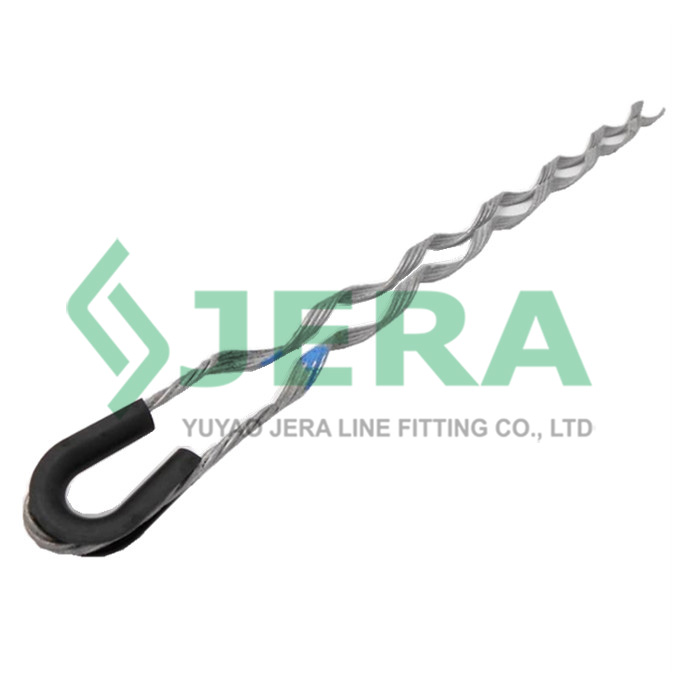
From the perspective of material mechanics, the shock-absorbing hammer, through its unique helical clamp design, can homogenize the pressure distribution at the contact point, keep the local pressure below 20 megapascals, and prevent micro-damage to the cable armor layer that exceeds 80% of its fatigue limit. This design can extend the expected service life of the cable from 25 years to over 40 years, while reducing the signal attenuation rate caused by vibration to 0.02 decibels per year. In its 2020 network upgrade report, Australian energy company Ausgrid pointed out that after deploying shockproof hammers along its 5,000-kilometer coastal route, the frequency of maintenance interventions decreased from 2.5 times a year to 0.8 times, directly reducing the annual maintenance budget by 300,000 Australian dollars and shortening the payback period to less than three years.
 In terms of dealing with dynamic loads, the shockproof hammer can effectively absorb the energy generated by ice load or traffic vibration, reducing the stress fluctuation range of the cable by 70% and keeping its amplitude always within the 50% safety threshold of the material's yield strength. Studies show that under harsh conditions where the ice thickness reaches 15 millimeters, the safety accident rate of systems using shockproof hammers can be reduced by 90%. Take the engineering projects of State Grid Corporation of China on the Qinghai-Xizang Plateau as an example. The average annual wind speed in this area reaches 25 meters per second. By applying the anti-vibration hammer solution on a large scale, the number of power transmission disruptions caused by bad weather has been successfully reduced from an average of 15 to 2 per year, and the system availability has been improved to 99.9%, just like putting on a tough armor for the fragile cable nerves.
From the perspective of full life cycle cost analysis, the initial installation cost of a high-quality shockproof hammer is approximately 5% of the total line cost. However, it can avoid an average repair cost of over $50,000 each time and service interruption losses caused by cable breakage over a 20-year operation cycle, and the internal rate of return is expected to exceed 25%. The European Electrotechnical Standardization Committee emphasizes in the EN 50341 specification that the compliant use of shockproof hammers is at the core of the risk control strategy. For instance, when the UK completed the cable relocation project along its HS2 high-speed railway, it made it mandatory to use certified shockproof hammers. This decision reduced the probability of change costs caused by cable stability issues in the later stage of the project from 15% to less than 2%, greatly ensuring the project budget and schedule, and highlighting the huge benefits of forward-looking safety investment.
In terms of dealing with dynamic loads, the shockproof hammer can effectively absorb the energy generated by ice load or traffic vibration, reducing the stress fluctuation range of the cable by 70% and keeping its amplitude always within the 50% safety threshold of the material's yield strength. Studies show that under harsh conditions where the ice thickness reaches 15 millimeters, the safety accident rate of systems using shockproof hammers can be reduced by 90%. Take the engineering projects of State Grid Corporation of China on the Qinghai-Xizang Plateau as an example. The average annual wind speed in this area reaches 25 meters per second. By applying the anti-vibration hammer solution on a large scale, the number of power transmission disruptions caused by bad weather has been successfully reduced from an average of 15 to 2 per year, and the system availability has been improved to 99.9%, just like putting on a tough armor for the fragile cable nerves.
From the perspective of full life cycle cost analysis, the initial installation cost of a high-quality shockproof hammer is approximately 5% of the total line cost. However, it can avoid an average repair cost of over $50,000 each time and service interruption losses caused by cable breakage over a 20-year operation cycle, and the internal rate of return is expected to exceed 25%. The European Electrotechnical Standardization Committee emphasizes in the EN 50341 specification that the compliant use of shockproof hammers is at the core of the risk control strategy. For instance, when the UK completed the cable relocation project along its HS2 high-speed railway, it made it mandatory to use certified shockproof hammers. This decision reduced the probability of change costs caused by cable stability issues in the later stage of the project from 15% to less than 2%, greatly ensuring the project budget and schedule, and highlighting the huge benefits of forward-looking safety investment.
In terms of dealing with dynamic loads, the shockproof hammer can effectively absorb the energy generated by ice load or traffic vibration, reducing the stress fluctuation range of the cable by 70% and keeping its amplitude always within the 50% safety threshold of the material's yield strength. Studies show that under harsh conditions where the ice thickness reaches 15 millimeters, the safety accident rate of systems using shockproof hammers can be reduced by 90%. Take the engineering projects of State Grid Corporation of China on the Qinghai-Xizang Plateau as an example. The average annual wind speed in this area reaches 25 meters per second. By applying the anti-vibration hammer solution on a large scale, the number of power transmission disruptions caused by bad weather has been successfully reduced from an average of 15 to 2 per year, and the system availability has been improved to 99.9%, just like putting on a tough armor for the fragile cable nerves.
From the perspective of full life cycle cost analysis, the initial installation cost of a high-quality shockproof hammer is approximately 5% of the total line cost. However, it can avoid an average repair cost of over $50,000 each time and service interruption losses caused by cable breakage over a 20-year operation cycle, and the internal rate of return is expected to exceed 25%. The European Electrotechnical Standardization Committee emphasizes in the EN 50341 specification that the compliant use of shockproof hammers is at the core of the risk control strategy. For instance, when the UK completed the cable relocation project along its HS2 high-speed railway, it made it mandatory to use certified shockproof hammers. This decision reduced the probability of change costs caused by cable stability issues in the later stage of the project from 15% to less than 2%, greatly ensuring the project budget and schedule, and highlighting the huge benefits of forward-looking safety investment.